
Last updated September 10, 2026
Full 25-point door and opener safety check with every visit - springs, cables, rollers, tracks, and your LiftMaster or Chamberlain opener included
You get a price before we start. It does not change when the truck arrives.
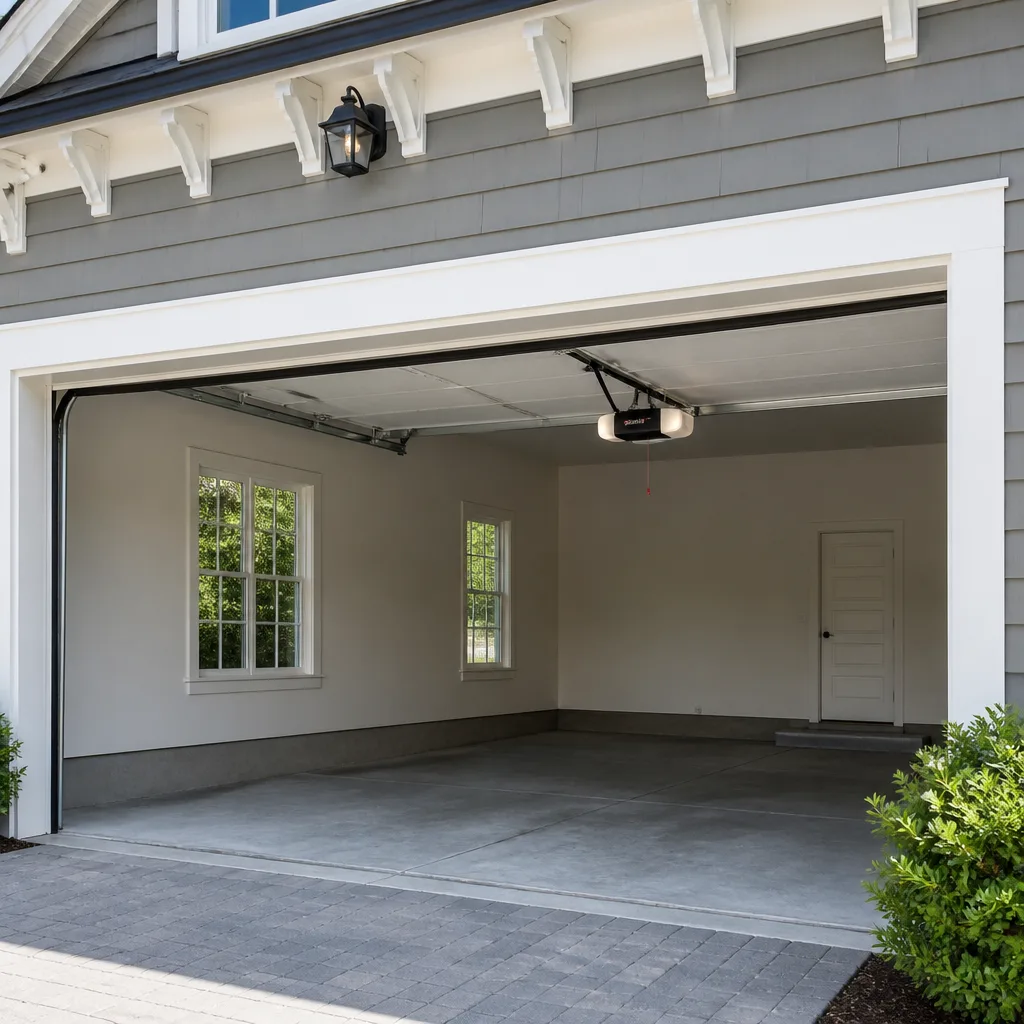
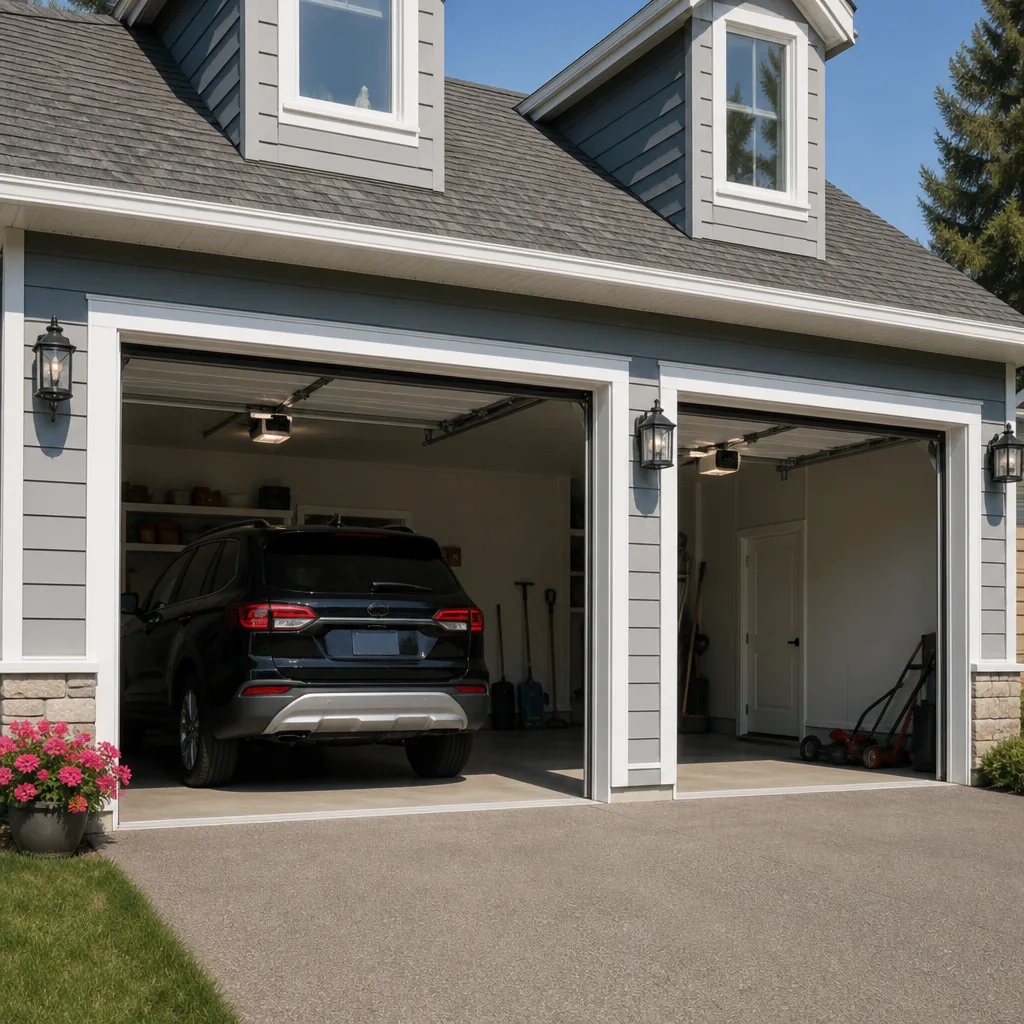
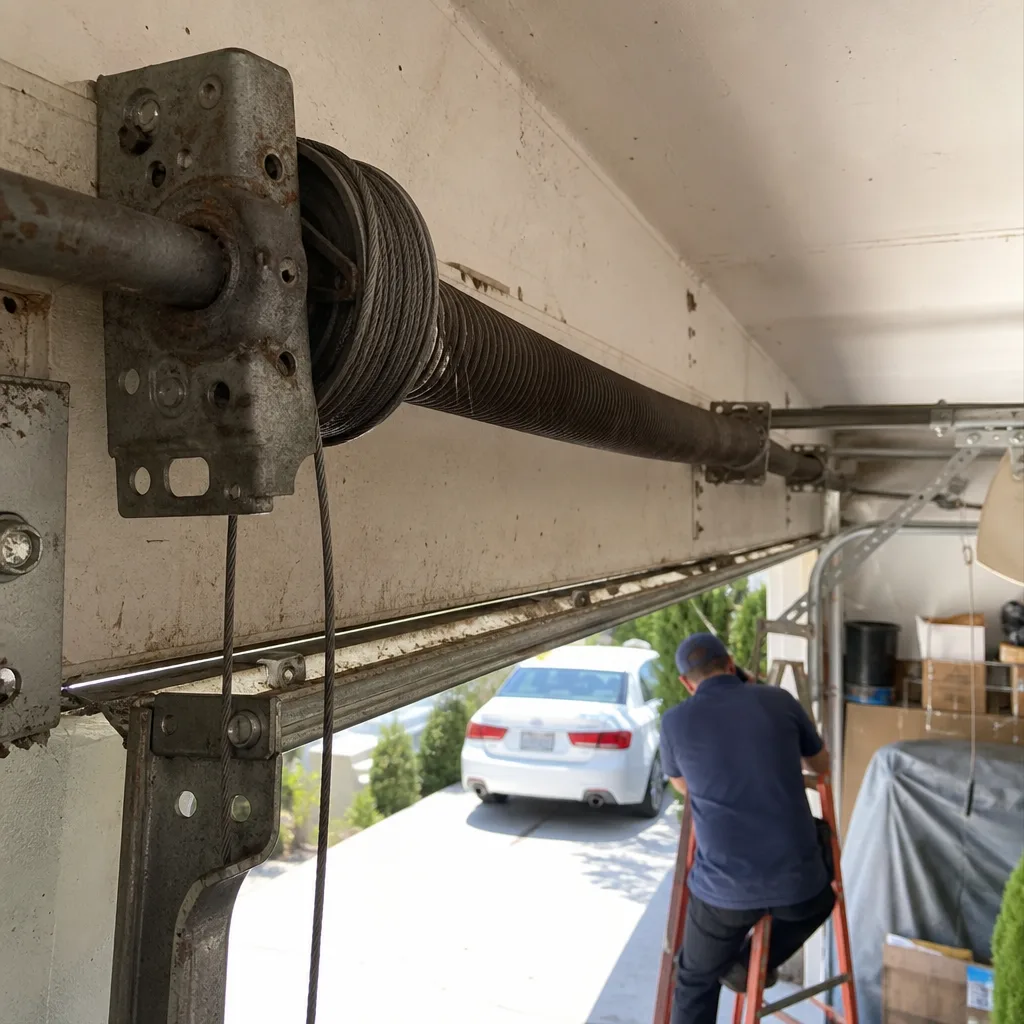 Before
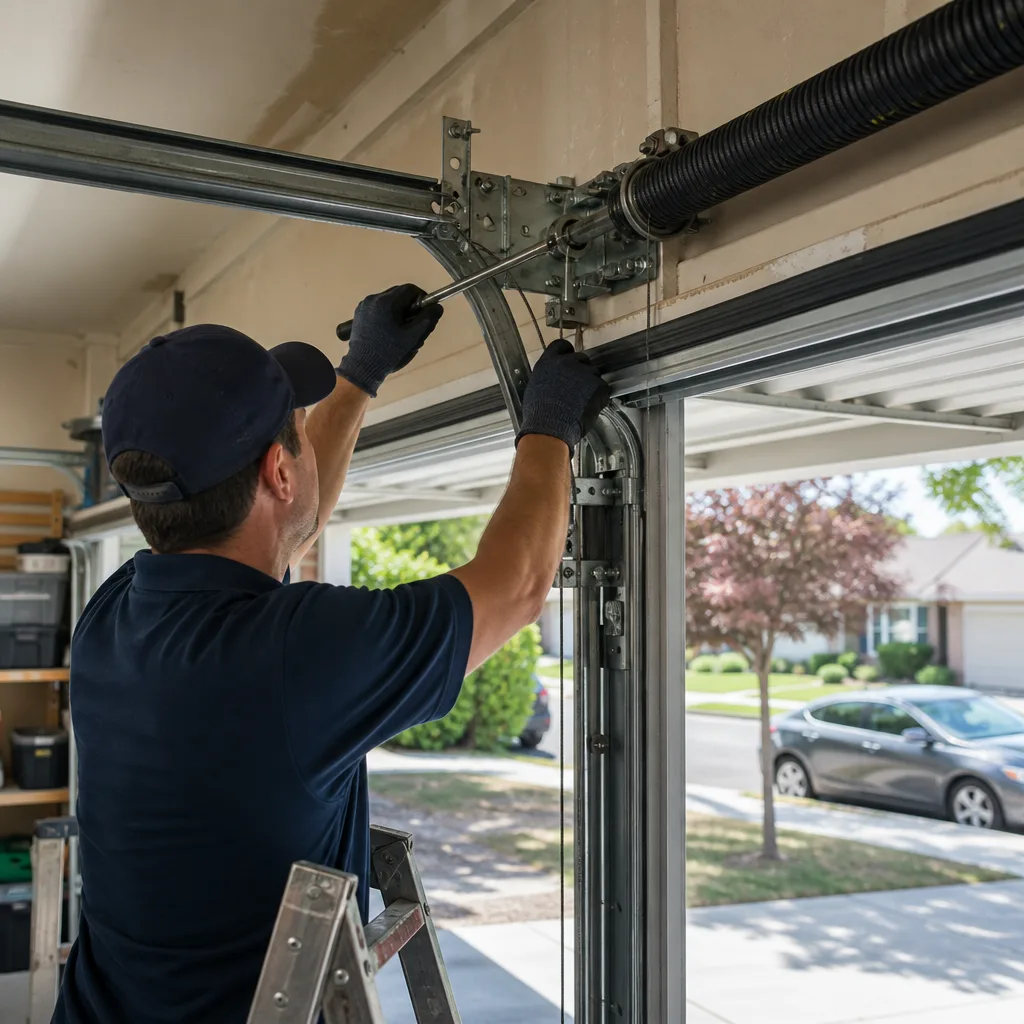 After
After Before
 After
After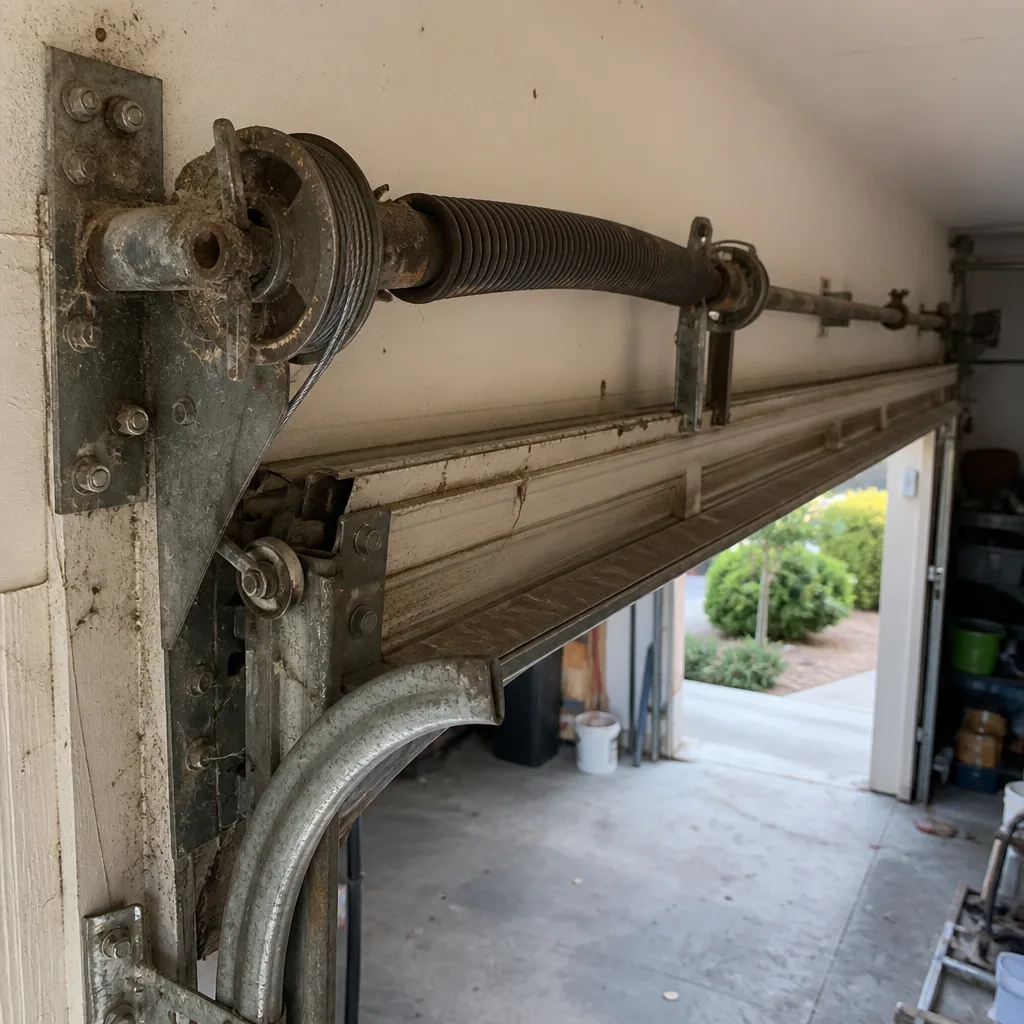 Before
 After
AfterSeasonal Garage Door Care for Thousand Oaks: Year-Round Homeowner’s Guide
The Santa Ana winds that barrel through the Conejo Valley in October and November do more damage to garage door weatherstripping and bottom seals in two weeks than a mild winter does in three months, and almost nobody in Thousand Oaks checks for it until the dust is already inside. Homeowners write off seasonal garage door care as something for Minnesota or Buffalo, but here the enemy is not snow. It is oven-dry heat that bakes rubber into brittle flakes, marine layer moisture that works its way into every crack, and wind gusts that flex an 8-foot door like a sheet of plywood. This guide lays out what actually needs doing, season by season, for a Thousand Oaks garage door, and you can find The Complete Guide to Garage Door in Thousand Oaks for deeper detail.
Quick Answer
Seasonal garage door care in Thousand Oaks means four distinct routines: post-Santa Ana seal and track inspections each fall, bottom seal and drainage checks before the winter rains, spring tension and balance testing when April temperatures swing, and summer opener force adjustments for heat-expanded aluminum tracks. Most tasks take under fifteen minutes and cost under twenty dollars in parts. Skip them, and the bill eventually lands in the hundreds.
Table of Contents
- Fall: What Santa Ana Winds Do to Your Door (and the 15-Minute Post-Wind Inspection)
- Winter and Wet Season: The Marine Layer, the Bottom Seal, and a $12 Fix Most People Miss
- Spring: Why Torsion Springs Snap in April, and How to Tell Yours Is Close
- Summer: Heat Expansion, False Triggers, and the Opener Adjustment That Takes Five Minutes
- The One Product Otto Keeps on His Own Garage Shelf
- Common Mistakes to Avoid
- When to Call a Professional
- Frequently Asked Questions
- The Bottom Line
Fall: What Santa Ana Winds Do to Your Door (and the 15-Minute Post-Wind Inspection)
Santa Ana winds hit Thousand Oaks with gusts that routinely top 40 mph in the foothill neighborhoods around Lynn Road and the canyons off the 23. A sectional garage door in good shape can handle that. A door with a single loose hinge or a weatherstrip that has been baking in the Conejo Valley sun all summer cannot. The wind grabs the loose edge, flexes the panel, and every gust works the fasteners like a pry bar. The bottom seal takes the worst of it. Wind-driven dust and grit gets forced into the gap under the door, abrading the rubber, and by the time the wind dies down the seal has worn through in one corner and you will not notice until the first rain.
Here is the inspection routine we recommend after every serious Santa Ana event in Thousand Oaks. It takes about fifteen minutes:
- Check the bottom seal at both corners. Squat down with the door closed and run your fingers along the rubber where it meets the concrete. Look specifically for tears, flattened sections where grit has ground it down, or a gap where the seal no longer touches the slab.
- Open the door and inspect the top weatherstripping. This is the rubber flap that runs along the header. Wind gets behind it and pulls staples or nails loose. If it dangles, it is doing nothing.
- Look at the side jambs. The vinyl trim along each vertical edge is the first line of defense against wind-driven rain. If it is cracked or pulling away, replace it now, not in January.
- Tug test every hinge and bracket that carries a panel. One hand on the hinge, one on the panel, and pull. Movement of more than a quarter inch means a fastener is loose or the hole has wallowed out.
- Listen to the door. Run it up and down from the wall button. A grinding noise that was not there in August is often a roller bearing full of blown dust. It will not heal itself.
If any of this turns up a problem, fix it the same week. A $15 bottom seal is a lot cheaper than the water damage and rodent entry that follow when the winter rains find the gap. The Santa Ana season moves fast here in Thousand Oaks, and the door that fails in a November windstorm is almost always the one that shipped September with a seal already half-dead.
If you find the door itself is in bad shape beyond the weatherstripping, see our full guide on Garage Door Repair in Thousand Oaks for what is worth fixing versus replacing.
Winter and Wet Season: The Marine Layer, the Bottom Seal, and a $12 Fix Most People Miss
Thousand Oaks does not get snow, but the winter marine layer arrives like clockwork, and when the Pacific fronts line up, we get real rain, sometimes inches at a time. The problem is not the volume. It is that the bottom seal you have had on the door for three years dried out during the summer and shrank just enough to leave a 1/16-inch gap at the slab. That gap is invisible until the first good storm drives water under the door and you walk into the garage Monday morning and find a puddle running from the corner toward the water heater.
Here is what happens, in order, and it is the same every year:
- The summer’s dry heat pulls moisture out of the rubber bottom seal, making it stiff and slightly shorter.
- The first few wet mornings of the season leave the concrete driveway damp, and water pools at the garage apron.
- Wind pushes that water sideways under the door through the now-tiny gap.
- The water follows the slope of the garage floor and collects at the lowest point, usually against the interior wall.
The fix is a new bottom seal, which costs around $12 to $20 at any Thousand Oaks hardware store for a standard 16-foot door, and takes about twenty minutes to slide into the aluminum track. The part most people miss is not the seal itself. It is the drainage check. If your garage floor slopes toward the interior, or if the concrete apron outside has settled over the years so that water sheets toward the door instead of away from it, a new seal will still leak. You need to check the drainage pattern, and if necessary, have a sweep installed on the outside bottom edge or address the apron slope. The seal stops the water at the door. The drainage keeps it from sitting there in the first place.
One more winter-specific item for Thousand Oaks: the marine layer means high relative humidity at dawn and cool afternoons. Condensation forms on metal parts that have been warming and cooling since October, and any scratch in the paint, any bare metal on a track bracket, starts to rust. It is slow rust, but it never sleeps. A light wipedown of the track and hardware with a dry rag every few weeks during the wet season costs nothing and will add years to the hardware.
If your opener is getting flaky during the damp months, read up on Garage Door Opener in Thousand Oaks for what moisture does to the logic board and safety sensors.
Spring: Why Torsion Springs Snap in April, and How to Tell Yours Is Close
Ask any garage door company in Southern California when they replace the most torsion springs, and the answer is not winter. It is spring. The reason lives in the metallurgy. A torsion spring is a steel coil under constant tension, and every time the door opens and closes, that coil flexes through a cycle. Steel under cyclic load develops microscopic fatigue cracks over time. The wild card is temperature. In Thousand Oaks, April and May bring cool 50-degree nights followed by 80-degree afternoons. The steel expands and contracts through that swing every single day, and the repeated thermal cycling makes the fatigue cracks propagate faster. The spring that survived all winter on borrowed time lets go on a sunny Tuesday in late April, usually when the door is down and the tension is at its peak.
When a torsion spring snaps, it sounds like a gunshot inside the garage. If it happens when the door is up, the door can slam down hard enough to crack a panel or bend a track. If the door is down, you are not opening it by hand; the weight of the door is too much for the opener alone, and forcing it will burn out the motor.
You can spot a dying spring before it goes. Look at the coil gap:
- The twist test: With the door closed, look at the spring along the shaft above the door. A healthy spring has a uniform, tight coil spacing along its entire length. If you see a gap that is wider in one spot, an uneven stretch, or separation of the coils, that spring is in failure mode.
- The rust test: Surface rust on a spring is not cosmetic. Rust pits the steel and gives the fatigue cracks a place to start. A spring with visible rust flakes is a replacement candidate now, not next year.
- The balance test: Pull the release handle and lift the door manually to waist height. Let go. A balanced door stays put. If it drops or climbs on its own, the spring has lost tension, and the opener has been doing the spring’s job. That extra load is why openers die young.
We count spring cycles the way you count tire miles. A standard torsion spring is rated for 10,000 cycles, and the average four-opens-per-day household in Thousand Oaks hits that in six to eight years. If your home was built before 2015 and you have never touched the springs, you are on borrowed time right now. Do not wait for the gunshot.
Summer: Heat Expansion, False Triggers, and the Opener Adjustment That Takes Five Minutes
July and August in Thousand Oaks push garage temperatures into the triple digits before you even factor in the afternoon sun hitting the door itself. Steel and aluminum expand in that heat, and a door that was perfectly aligned in March can bind against the tracks by July. The symptom that drives people crazy is the opener false-triggering. The door starts closing, stops halfway, and reverses back up for no reason. Or it will not close at all, and the lights on the opener flash like a turn signal at midnight.
The cause, nine times out of ten, is not a bad opener. It is heat. The safety system built into every opener since the early 1990s measures the force the motor uses to move the door. When heat expansion makes the door bind against the vertical tracks, the opener reads that extra resistance as an obstruction, just like it would read a bicycle left under the door, and it reverses. The fix is an adjustment, not a replacement.
Most modern openers from LiftMaster, Chamberlain, and Genie have two small plastic screws on the motor housing, or a digital menu on the wall panel, labeled for up and down force. The summer fix is to increase the down force about one quarter turn or one step at a time until the door closes smoothly from full open to full closed. Go incrementally. Too much force is where fingers get pinched and panels get cracked. If you are not comfortable with it, this is a five-minute service call, not a maintenance project. But understand: if your opener reverses repeatedly in August and then works fine again in October, the opener is not haunted and it is not broken. It is just summer.
There is a second heat item worth mentioning. The safety sensor eyes near the bottom of the track can shift in the heat as the mounting brackets expand. If the two eyes fall out of alignment and the beam breaks, the door refuses to close. Check that the small lights on each sensor are both lit, and that the units point directly at one another. A fingertip adjustment to realign them fixes the problem in seconds.
If you live in a neighborhood with direct afternoon exposure, like the hillsides off Erbes Road or the tracts east of the 23 heading toward Newbury Park, your door absorbs more heat than a shaded lot off Moorpark Road. Adjust forces earlier in the season, and save yourself the false-alarm call to a technician.
The One Product Otto Keeps on His Own Garage Shelf
It is not WD-40. Everyone sprays WD-40 on garage door tracks and hinges because that is what their father did, and within a month the tracks are a gummy black mess that collects dust, and the hinges are squeaking again. WD-40 is a solvent and a water displacer, not a lubricant. The product we use and recommend for metal-to-metal contact on a garage door is a dry white lithium grease or a silicone spray designed for garage door hardware. Both go on thin, dry, and do not attract Conejo Valley dust. The key word is dry.
What gets lubricated, once per season in Thousand Oaks, about fifteen minutes of work:
- Rollers: The metal wheel bearings on each roller are the highest-wear point on the whole door. A quick squirt on each bearing stem, not the track itself.
- Hinges: Both halves of every hinge where the panel faces pivot. If the hinge has a grease fitting, use it.
- The torsion spring: A light coat across the coils prevents surface rust and keeps the coils from grinding against each other as they wind and unwind. Do not soak it.
- The opener rail: If you have a chain drive, a light oil on the chain. If you have a screw drive, white lithium grease along the length of the screw.
Do not lubricate the track itself. The rollers ride on bearings, and the track should stay clean and dry. Greasing the track is how you end up with black streaks down the side of your door and a roller that skids instead of rolls.
If you ever need help matching a seal, a spring, or a hinge to your door, check out Garage Door Installation in Thousand Oaks for guidance on parts and compatibility, or give us a call.
Common Mistakes to Avoid
- Waiting for a problem to start maintenance. In Thousand Oaks, the door that gets service only when it breaks is the door that breaks at the worst possible time, usually the morning of a family event or the night before a trip. Seasonal checks are cheap; emergency calls are not.
- Spraying WD-40 on everything that moves. It strips the existing grease, leaves a solvent residue, and collects grit. Use a dry lubricant made for garage door hardware, and use it on the bearings, hinges, and spring, never the track.
- Ignoring a slow opener. An opener that takes longer than it used to, or strains audibly, is telling you the spring is weak or the door is binding. The opener is compensating, and that shortens its life by years. The problem is almost never the opener itself.
- Replacing the weatherstripping without checking the slab. If the concrete has settled or the apron slopes toward the door, a new seal will leak just like the old one. Fix the drainage, then the seal, in that order.
- Painting over rust on a torsion spring. Paint hides the rust but does not stop the fatigue. The steel underneath is already compromised. A rusty spring gets replaced, not painted.
- Adjusting the opener force too high to fix a binding door. This turns a misalignment into a safety hazard. The door should move freely by hand before you ever touch the force settings.
- Skipping the post-Santa Ana check because the door opens and closes fine. The damage from wind is not in the movement; it is in the seals, the hinges, and the track alignment. The door works until it does not. Wind damage compounds.
When to Call a Professional
A broken torsion spring is not a DIY job. The spring holds the entire weight of a 200-pound door under high tension, and when it lets go, the ends move fast enough to break a wrist or worse. Call a professional. Same goes for a door off its track, a snapped cable, or a bent track from a wind gust or a vehicle tap. If your opener is reversing in warm weather and a force adjustment does not fix it within one or two increments, stop and call rather than cranking the settings. Otto’s Garage Door offers free estimates in Thousand Oaks, and we hold the quoted price when the truck arrives. The number is (805) 519-7431.
Frequently Asked Questions
Four light seasonal checks per year, with a professional inspection every two to three years, covers most Thousand Oaks doors. The fall check after the first Santa Ana event and the spring balance check before the April temperature swings are the two that prevent the most breakdowns. Call (805) 519-7431 if you would rather have us do the inspection; we will give you an honest assessment without pushing work you do not need.
A basic DIY seasonal check costs $15 to $30 in parts if you replace a bottom seal or grab some lubricant. A professional inspection and tune-up in the Conejo Valley typically runs between $85 and $150 depending on what needs adjustment; see our Garage Door Cost Breakdown: The Thousand Oaks Homeowner’s Reference for 2026 for full pricing context. We quote every job before we start, and the price on the phone is the price on the invoice.
Heat expansion makes the door bind against the tracks, and the opener’s safety system reads that resistance as an obstruction, triggering a reversal. It is a common Thousand Oaks summer problem, especially on west-facing doors in the afternoon. A small force adjustment typically fixes it. If you would rather not mess with the settings, call us and we will handle it in one visit.
Yes, on most residential doors this is a straightforward job: pull the old seal from the aluminum track or channel, slide in the new one, and trim the ends. The part is under $25 at local Thousand Oaks hardware stores. The tricky part is matching the seal profile to your track channel, because there are four or five different shapes. If you bring us a photo or a sample, we can tell you which one you need.
Most standard torsion springs last six to eight years in Thousand Oaks with normal use and the thermal cycling we get each spring and summer. Higher-cycle springs rated for 20,000 to 30,000 cycles can double that. The number that matters is your usage, not the calendar.
Indirectly, yes. The cool, moist air promotes condensation on metal parts, which accelerates surface rust on hinges, brackets, and springs. It also hides in the gaps of wood or faux-wood doors, where it can cause paint blistering and swelling over repeated seasons. A dry wipe-down during the damp months and a coating on exposed metal is enough to stay ahead of it.
The Bottom Line
Thousand Oaks does not have a snow season, but it has a wear calendar all its own: Santa Ana winds in the fall, marine layer moisture and rain in the winter, thermal spring swings that kill tired springs, and summer heat that makes the opener question everything. Four fifteen-minute seasonal checks, a $12 seal here, a squeeze of lithium grease there, and you will avoid almost every breakdown the Conejo Valley throws at a garage door. And when something does break, call someone whose name you can verify and whose face you will see again at the hardware store, or browse our more guides & resources for ongoing maintenance help.
For more from the Otto’s Garage Door home base, we are here when you need us: call (805) 519-7431 for a free estimate, a second opinion, or a straight answer on whether that spring has another season in it.
Written by Otto Reinhardt, Owner at Otto’s Garage Door, serving Thousand Oaks since 2004.